Sunday, November 22, 2009

Review: The Teahouse Fire by Ellis Avery


For the Historical Tapestry challenge. Note there are 2 As here!


At the end of the American civil war, young Aurelia, through a series of tragic turns, finds herself transported from New York and orphaned and alone in Japan. She stumbles upon a teamaster's estate at a time when Japan is closing itself to all foreigners. Through the good fortune of her dark hair and the kind heart of the teamaster's daughter, Aurelia is taken in and becomes a servant to the family, presumed by her benefactors to be traumatized and ugly but still Japanese. Ellis Avery's story chronicles the girl's development into a young woman just as Japan evolves into a modern nation.


The novel does a lovely job of capturing the beauty and mystique of temae, the Japanese tea ceremony. Avery spent years studying temae, yet she makes it accessible to the novice without being didactic. In fact, I think it'd be accurate to consider tea as a separate character in the novel, as tea helps define the characters while they, in turn, struggle to keep temae relevant in changing, modernizing Japan. Similarly, Aurelia struggles with her identity, trying to reconcile her Westerness with her new, adopted Japanese-ness. After decades in Japan, her native languages hang awkwardly on her tongue, illustrating vividly the internal conflicts she faces.


The two central tensions of the book are Aurelia's identity conflict and her romantic travails. The first is illustrated with delicacy and poignancy. The second, however, rang a little false to me. Without dropping any spoilers here, I will just say that Aurelia's unflailing devotion to one love, who seems to use her, as well as her lingering passion for another love after a brief encounter, both felt a little difficult to understand. But, with a touching ending (I think I teared up), The Teahouse Fire is a beautiful, sensitive book that leaves the reader satisfied, if longing for a little whisked tea.

Tuesday, November 17, 2009

On catching, or writing, the mouse


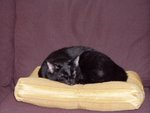
My cat, apparently, has an intuitive understanding of what makes "interesting." He pointed out to me today that, when sitting in a laundry basket, it is far more entertaining to try to catch the catnip-filled toy mouse through the holes of the basket than it is to simply reach up and over. When he can see all the mouse in its lame, grey cloth glory, the game loses its fun. Its mystery.

Which I guess is something of a reminder for writing, no? You can't just walk out naked onto the first page, you have to reveal your bits and pieces slowly. (Not to mix metaphors, or anything.)

No big revelation, but it does allow me to post a picture of my cute cat, Nuublay.

Thanks kitty.

Sunday, November 15, 2009

A Holocaust Survivor

Today I heard a Holocaust survivor speak. George Pick turned ten years old the day he, and the other Jews in Hungary, were ordered to wear gold stars on their clothing. For the remaining months of 1944, through the end of the war, he and his parents endured 22-hour long curfews, hid in a factory, and feared for their lives. George saved his own life when he and a friend escaped from the Swiss orphanage to which they'd been sent for safe-keeping; two days later, the twenty other Jewish children kept there were shot next to the Danube River.

I'm still astonished by the experience. Selfishly, I can't believe I got to hear the story straight from the lips of someone who lived it. But more deeply, I'm reminded of the horror of the Holocaust - something that is easy to forget, as it is so difficult to comprehend. How could so many people become so hateful, while even more look on in indifference, or, at best, cowardice? How could they forget that those they killed were people, individuals with stories and feelings? Eichmann in Jerusalem has some interesting discussion of that, as do many other works, but in spite of reading about it, it's still nearly impossible to truly, truly feel, to understand it as something people lived through and died in.

Which, as usual, brings me to reading - not to understand after the fact (which is, of course, essential), but to try to prevent these things from happening in the future, to guard ourselves from indulging in such hate. Reading fiction is perhaps the most empathetic act we can do - inserting ourselves into the mind of a character. If the writer is doing her job, that character is truly human, and we feel through them. I can't help but believe that the more we read, the more human we become, through the forced exposure to other people's stories and other viewpoints. I realize reading is by no means a panacea (hell, Hitler read a ton), but I firmly believe that it opens a door, or at least has the possibility of doing so. And the more doors we crack open in our souls, the more we are willing to explore each other, the fewer chances for horrifying dehumanization. It's worth a shot, at least.

* A note: With all my emphasis on the moral enrichment available from reading, that doesn't mean I've forgotten that reading should also be ridiculously, overwhelmingly fun and entertaining. Not in the way that brussel sprouts are good for you but also a little tasty, but in the way that dark chocolate has anti-oxidants. So does red wine. Yum.

Saturday, November 14, 2009

A Coffee Bridge

For Erin, who's making her own leap.

It started with the coffee shop. Each day, from 2-3pm, Marlene would escape, before the kids got home from school, before she had to start cooking dinner. She knew she was out of place in the hipster hangout, all worn vinyl booths and retro stained glass lamps, but she loved it nonetheless. She liked feeling transported into a more rarefied world, pretending that she was one of its denizens, even as she knew that no one truly belonged to the life she imagined the coffee shop held. Marlene sipped her rich coffee and stared out the picture window. She particularly liked it when it rained.

One day the coffee shop switched its black-and-white photos, hung rakishly across the walls, for some bright oil paintings. Beside each was a cream-colored business card displaying a scrawled price and the artist's name, Y. Peirte. Marlene stared, fascinated at the paintings. They glowed blue and green and yellow, but didn't speak to her at all. In their failure to grab her they intrigued. I could do that, she thought. Maybe even better. Maybe.

For three weeks, she stared at the garish paintings. She wondered about the artist, Y. Peirte, wondering if the paintings sold, if they provided a livelihood, or just satisfaction. After three weeks, her heart pounding, she bought two canvases, twenty paints, and five brushes from an art supply store.

For another week, she continued going to the coffee shop, but now it was only to hide. As she stared out the window onto the sidewalk, all she could see were the colors of her paints and the blank canvas.

One day at 2pm, Marlene inched her way towards the closet where she'd stashed her supplies. She pulled the bag up into the attic, laid everything out on the rough plywood floor. First a dab of blue, then of red. Mixed, made purple. The thoughts, feelings that had been percolating in her mind over the past few weeks slowly trickled onto the canvas. The art lessons from her youth crept up to the surface of her mind and her hands. She painted.

She painted each day, from 2-3pm. Bought another canvas, and painted some more. Sometimes she hated it, sometimes she loved it. But always she painted, always in secret. Her husband suspected, but he caressed her cheek and knew not to ask. She was terrified to reveal herself.

It was a year before she returned to the coffee shop. She didn't recognize the barista anymore, which made her both sad and giggly. Marlene drank her coffee, sipping from the edge of the white porcelain cup. When she finished, she rested it carefully in the saucer and, glancing at the paintings - different - on the walls, approached the clerk.

"May I speak to your manager?" she asked.

"That's me," the young woman replied, wiping her hands on her brown apron.

"I was wondering ..." Marlene mumbled, and lay a battered white envelope on the counter. Out from it she pulled eight photographs. Her paintings.

Gingerly, woman shuffled through the photographs.

"For the shop, you're thinking?"

"Yes," Marlene said, little more than a whisper.

The woman smiled. "Wonderful."

Learing about tolerance from books ...


... Or at least from this one. I stayed up until midnight last night to finish this book, which says something about how good it was - one, because it was Friday night and typically from the hours of 7pm-midnight on Fridays I transform into an 80-year-old, and second, because I'd been awake since 3:40 am that day (thanks kitties). The Silence and the Scorpion evaporated my fatigue however, as it is both a gripping, page-turning action story and a haunting lesson on what can happen to a polarized society.

Brian Nelson walks us through the dramatic events of April 11-14, 2002 in Venezuela, describing the euphoria and then terror of the marchers on the presidential palace, the resentment of the president's supporters against the previous robber regimes, and the chaos that unfolded as Venezuela went through three presidents in as many days. In the end, Venezuela emerges from the crisis not stronger and more unified, but more polarized, as both the president's supporters and opponents vilify the other, each searching to shape the "truth" to fit their own needs. Nelson makes it clear that the deaths that resulted from the April tumult and the persecution that follows stem from a divided society, one where its members forget their shared humanity and only villify each other.

This story, of course, is nothing new in the history of the world. But by learning of it, and the others like it, I hope we can remind ourselves what comes from extreme division and rancor. When we slander our political opposites with crude exaggerations ("Nazi," "traitor," "liar," "stupid") we're working to strip them of their personhood, to allow ourselves to believe that we have all the right and they are abstractions of evil. What a load of nonsense ... I hope we can all remember that. So, angry Tea Partiers and judgmental Green Tea Sippers and everyone in between (look at me pulling out the stereotypes), how about taking a deep breath, reminding ourselves that our opponents do have some good motives, and trying to tolerate each other? If not, we could end up here.

Sunday, November 8, 2009

Literary versus Commercial? Bah!


"Few professors of English literature will ever admit to it, but the truth is that popular writers have had just as great an effect on the people of this nation as Dickens, Poe, or Melville and their classic works." Editor James L. Collins (copied from http://www.shellythacker.com/marketsavvy.htm)

This quote and its bedfellows confuse me. Why is "classical" literature assumed not to be "popular"? (I'm no literary scholar, but wasn't Dickens incredibly popular in his lifetime? I think the other two were as well.) Why do "literary" writers eschew a desire to please? I wonder if this isn't a 20th/21st century phenemenon, where artists react to the mass-commoditization of culture by attempting to make their products less accessible. For example, the classics of the plastic arts that we now revere (Rembrandt, Velasquez, Titian) were often intended by their makers to please their elite patrons, even if they were willing to push the envelope with what their customers found pleasing. Contrast that to some contemporary art that seems intended to provoke.

As for writing, I think we are misguided if we separate pleasure-inducing commercial literature from high-minded aesthetics. Fiction is beautiful because it speaks to our deep-seated desire for narrative. Language is stirring because it demonstrates our unique ability to create and shape images and feelings. There's no reason not to blend them. And that, in my mind, is the highest goal - a great story written with panache. I realize that conclusion is shared by many, but still people seem to brandish the false divide between "literary" and "commercial." Let's admit our base need for a story and celebrate the thought-provoking power words have.

Wednesday, November 4, 2009

The Ideal Costume

Sam breathed deeply, filling his chest with pride as he carried his bag into the bathroom. Below the shiny red paper the bag held a greater treasure than the Christmas present it once contained. Glancing around shyly, he determined he was best off stepping into a stall to effect his transformation. Not impressive if he did it in front of the other boys, he concluded, closing the door behind him. Slowly, with reverence, he extracted the two pieces of black clothing. Stepping carefully on the tops of his sneakers, he wiggled out of his blue jeans and slipped into the black cotton pants. He shed his t-shirt and struggled with the buttons as he closed the black shirt. The outfit was a little larger than he'd hoped, but he knew he still looked like his brother's magazine. Sam had only snuck glances at the forbidden pages, contraband even for his older brother to hold, but he had seen enough to both fall in love and know how to mimic it.

He pulled the black hat down over his head and carefully, balancing, he stepped into the black shoes usually reserved for church. Satisfied with his transformation (even if he wished the hat had a brim going all the way around his head, like the picture), he smushed his Sam Clothes into the bag and strode out of the stall. Seeing the bathroom empty, he panicked and hurried to find his class.

Sam found the tail end of his class's column, and wedged himself in place next to Geena, the witch, and Darius, Spiderman. Darius gave him an appraising glance and whispered, "Cool costume! You're a ninja, right? Where are your, uh, nunchucks?"

Sam's eyes widened with horror. "No! I'm a spy!" He hissed. "Like Spy vs. Spy, you know!"

Darius shrugged and turned his attention to the front, as the march had started. They shuffled down the hallway and out the front doors, blue paint peeling, into the cool, damp day. Sam nudged his way past Darius and Geena, looking for Jimmy. Jimmy would know who he was.

The parents lining their parade route cheered and clapped for the shuffling feet, many of which were trying not to slip on the wet leaves in their unusual shoes. Sam scanned the crowd, but saw no familiar faces. He reached out and tapped a green shoulder.

"Jimmy!" He exclaimed. "You're Frankenstein, right?"

"You bet," his friend confirmed, eyes gleaming through the tiny holes in his plastic mask. "And you're ... Wait, I can't see with this thing on. Uh, a man witch?"

"No!" Sam pouted. "A spy!"

As they walked, Sam's ears caught whispers from the sidelines ... "Look at the Frankenstein! And the ninja!" "Well, what's that one, a ninja?" "Ninja," "Warlock ..." Blushing, angry and embarrassed, he turned his eyes to his shoes. Black, shiny, they kicked up clumps of brown leaves.

Suddenly, he smiled. He squared his shoulders, looked up, and smiled at the crowd. He almost waved, like a beauty queen, but caught himself. That's right, Sam thought. A ninja, a witch. You'll never know what I really am, and that's how I like it. Only I know who I am.

Princess Nijma

Princess Nijma